
Best Gravel for Your Driveway: Types, Sizes, and How Much You Need
You spent time and money laying down fresh stone, then spread and raked it until it looked just right. But one heavy rain rolls through, and half of it ends up in the ditch or at the bottom of the hill.
It's frustrating, and it hurts to watch your hard work wash away. Choosing the best gravel for your driveway shouldn't feel like a guessing game, but labels like "57" and "67" don't tell you much on their own, and ordering too little means a second delivery.
That's where Ebyland comes in. Our Cumberland landscape center has served homeowners across Western Maryland and the surrounding tri-state area since 2002. We carry the gravel and stone driveways need, and our team is happy to help you choose the right type, size, and amount for your project.
So let's keep it simple. Here's how to match the type, size, and amount of gravel to your driveway so your stone stays where you put it.
TL;DR - Best Gravel for Your Driveway: Types, Sizes, and How Much You Need
No time to read? Here's the short version.
- Crushed stone (57 gravel, 67 gravel, and crusher run) works best. Round stones like pea gravel shift under tires.
- Build two layers: crusher run for the base, 57 or 67 gravel on top.
- Plan on at least 4 inches, and go deeper for soft soil or heavy loads.
- The math: length × width × depth (in feet) ÷ 27 = cubic yards. Multiply by 1.4 for tons, then add 10%.
- Drainage and compaction matter as much as the stone you pick.
3 Types of Driveway Gravel That Hold Up
Not every stone is suitable for tires, but these three are.
The best driveway stone is crushed, not rounded. Crushing leaves sharp, angular edges that lock together under weight. Smooth stones tend to roll out of place. Natural gravel like pea gravel also works, but often needs edging to stay in place.
Here's what we stock for driveways:
- 57 Gravel
- Size: roughly ¾ inch
- Compaction: minimal
- Best for: driveway surface and drainage
- It's graded with no fines, so water drains right through it.
- 67 Gravel
- Size: roughly ½ inch
- Compaction: minimal
- Best for: driveway surface and drainage
- It works the same way in a slightly smaller stone.
- Crusher Run
- Size: fine dust up to ¾ inch
- Compaction: heavy
- Best for: base layer
- It mixes stone dust with larger pieces. It packs into a firm base, but only if you compact it well.
Want to save a little? Crusher run costs less per ton than 57 or 67 gravel, so using it for your base keeps your budget in check.
Gravel Sizes Explained: 2 Layers Every Driveway Needs
The numbers tell you the stone size. The rule is simple: the higher the number, the smaller the stone.
Think of your driveway like a house. The base is the foundation. The top layer is the floor.
- Base layer: Crusher run packs tight and gives you something solid to build on.
- Surface layer: 57 or 67 gravel. It drains well, locks together, and gives you a clean surface to drive on.
Why two layers? Crusher run packs into a firm foundation, while 57 or 67 gravel gives you a clean, well-draining surface.
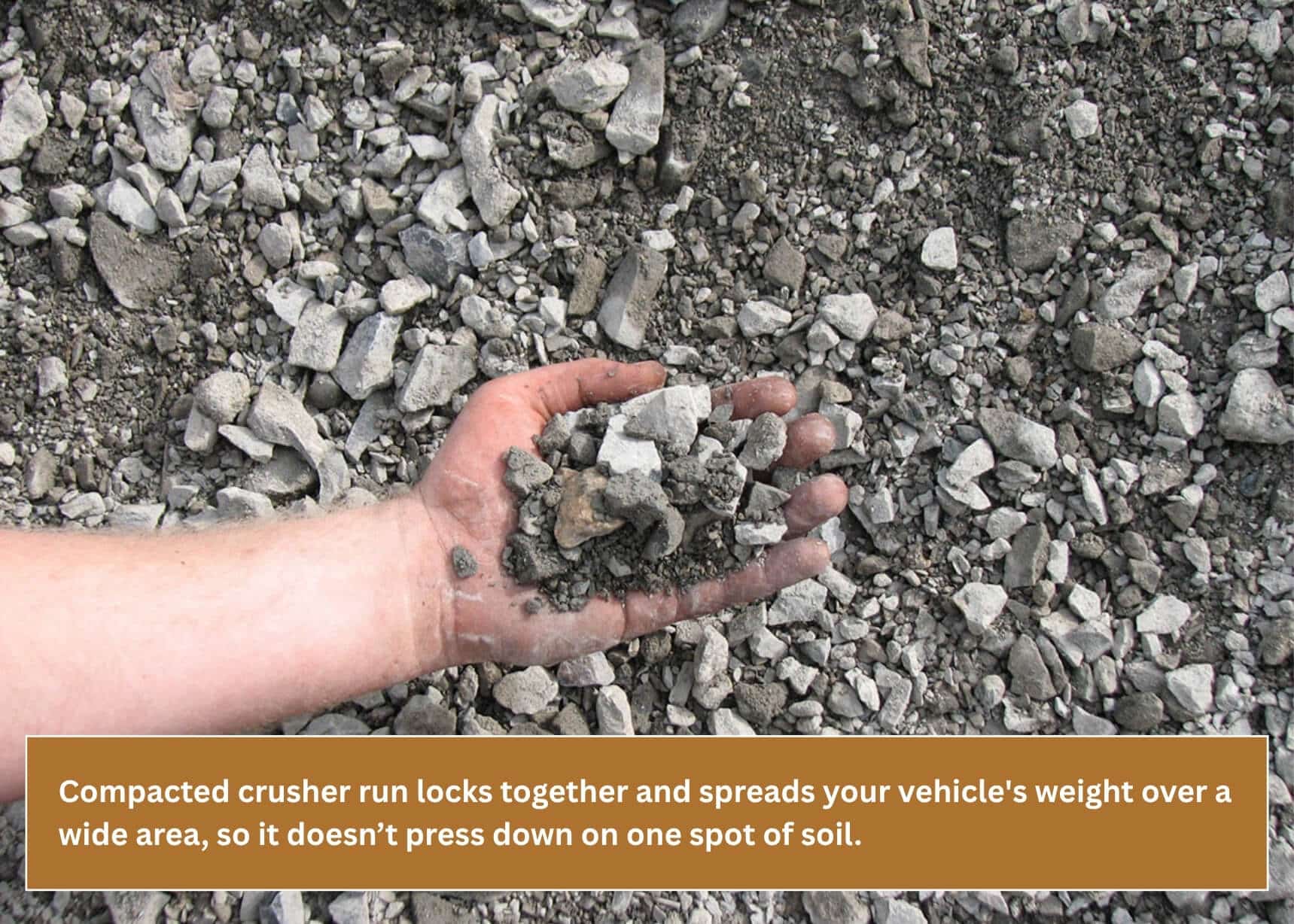
Layering also keeps a driveway from sinking. Compacted crusher run locks together and spreads your vehicle's weight over a wide area, so it doesn’t press down on one spot of soil. It also lets water drain through instead of pooling and softening the ground below. If you skip it, the top stone gets pushed into the dirt, which is how ruts start.
3 Things That Decide How Deep to Spread Gravel
There's no magic depth, but these three factors will help you decide how deep to go.
- Your soil. Soft, wet ground needs more stone to carry weight.
- Your traffic. A daily commuter car is easy on a driveway, but a loaded truck or trailer is not.
- Your climate. Freeze-thaw cycles heave the ground and can push base stone into the soil below.
So how deep do you need to go? Bob Vila's gravel guide recommends 4 inches for most new driveways, but also suggests a 6-inch base with a 2-inch top layer. Plan to go deeper if your ground stays soggy or you haul heavy loads.
Not sure where you fall? Tell us about your soil and how you use your drive. We'll help you pick a depth that fits.
How Much Gravel You Need in 4 Steps
Ordering the right amount the first time saves you money and a second delivery fee, and the math is easier than it looks.
- Measure the length and width of your driveway in feet.
- Pick a depth and convert it to feet. Four inches is about 0.33 feet.
- Multiply length × width × depth, then divide by 27. That gives you cubic yards.
- Convert to tons and add 10%. About 1.4 tons of stone make one cubic yard.
Here's an example for a 12 × 50 foot driveway, 4 inches deep:
- 12 × 50 × 0.33 = about 200 cubic feet
- 200 ÷ 27 = about 7.4 cubic yards
- 7.4 × 1.4 = about 10.4 tons
- Add 10% for settling and uneven spots: about 11.5 tons
Going 6 inches deep? Plan on about 17 tons.
We sell gravel by the ton, and each product page has a calculator that shows cubic yards and tons. Enter depth in inches and length and width in feet. Try it on our 57 gravel page.
5 Gravel Driveway Mistakes and Easy Fixes
Most gravel driveways fail for a few common reasons. Here's how to avoid them.
- Skipping the base. Stone laid straight on soil sinks. Build in layers, starting with crusher run.
- Skipping compaction. Left loose, crusher run settles on its own and can throw off your whole driveway. Compact it before you add the top layer.
- Ignoring water. Runoff regularly erodes and washes out driveways. Crown the surface so it sheds water. The University of Maryland suggests "slow it down, spread it out, and soak it in," and for bigger drainage problems, your local conservation district may be able to help.
- Skipping fabric on soft ground. On soft or wet soil, fabric helps keep your base stone from sinking into the dirt below. We recommend geotextile fabric on hardscape projects, and we're happy to help you decide if your driveway needs it.
- Forgetting upkeep. Rake bare spots and plan to add fresh stone every 2-4 years. Penn State even runs a research center for dirt and gravel roads, because unpaved surfaces need care.
Pickup or Delivery: 2 Easy Ways to Get Your Gravel
Once you know your number, getting the stone home is easy.
- Pickup: Bring a truck or trailer to our Cumberland store. No appointment is needed during business hours, and we'll load you up.
- Delivery: We like to deliver within 2 business days, sometimes 3 when we're busy. One delivery can carry up to 22 tons, and the price depends on your delivery zone. We deliver to places like Frostburg and Hancock. Not sure whether we deliver to your address? Give us a call.
Your Driveway, Done Right: 3 Next Steps
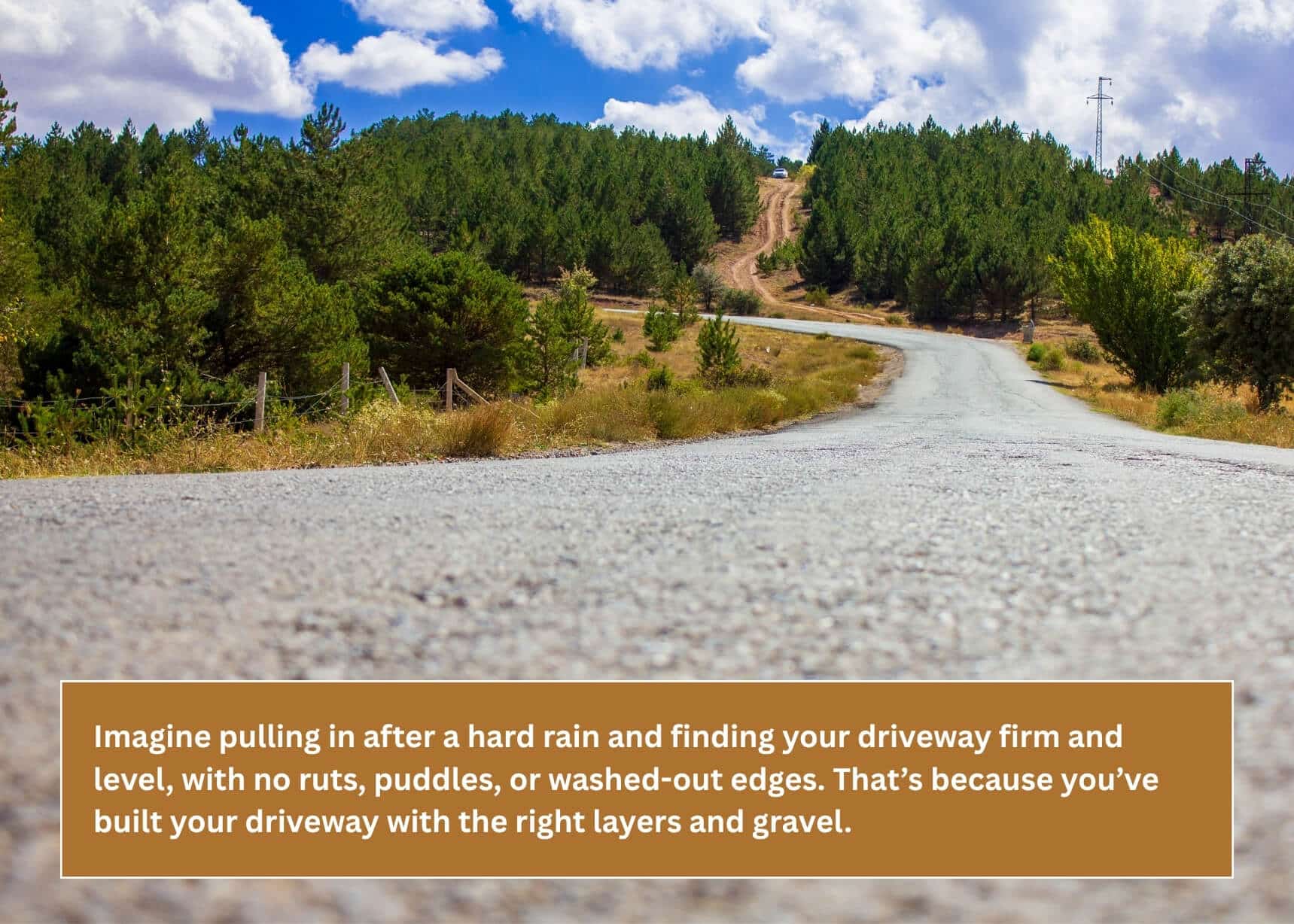
Imagine pulling in after a hard rain and finding your driveway firm and level, with no ruts, puddles, or washed-out edges. That’s because you’ve built your driveway with the right layers and gravel.
But you don’t have to imagine it. Here's how to get there:
- Measure your driveway and run the numbers above.
- Talk to us. Contact us or call 240-792-7719, and we'll help you choose the right stone and depth.
- Order. Shop gravel and sand online for pickup or delivery.
We've served Western Maryland, South-Central Pennsylvania, and Northern West Virginia since 2002, and we're happy to walk first-timers through every step. Need help with the install? Let us know, and we'll connect you with a local landscape or hardscape contractor we trust.
To learn more, read our guides on choosing the best hardscape materials and choosing landscaping materials.